Like most other pen companies Parker had been working for decades to find the perfect filling system and when the Parker "61" was finally introduced in 1956 it was really like a pen from another world, as it was initially advertised. It had many features in common with the predominant Parker "51" of the day, but it was slimmer, cooler and, most of all, it filled itself. Nobody really knew how it worked, but it did. All pens up until the Parker "61" had had some sort of mechanical filling system or had to be filled with an eyedropper or syringe. Most had levers, plungers or filling buttons to be pressed. The Parker "61" had non of that, just a mysterious black cylinder with some small holes in it at the end. You just unscrewed the back and put the pen in the bottle for thirty seconds and ... voilá ... the pen was filled.
There were three downsides to the fountain pens of the 1950's. The ball pen had arrived and the public was enchanted by this new pen that didn't need to be filled from a bottle and didn't cause ink stains. There had been many different solutions for keeping hands clean. The most successful up to then was the Sheaffer Snorkel, introduced in 1952. It utilised a sort of syringe under the ink feed that could be inserted into the ink and then screwed into the pen again after filling. No need to wipe a stained nib.
In a 1989 Pen World interview Don Doman, a legendary designer who designed the exterior of the Parker "61" and many other pens for Parker, revealed that Parker during the Parker "51" era recieved many complaints regarding the hidden nib which made it hard to quickly determine which was up and which was down of the pen.
Don Doman had an easy and attractive solution to the problem. He proposed an inlaid arrow on the gripping section, just above the nib.
Initially there plans to glue the arrow to the body but Doman argued that the arrow then would too easily fall off. He wanted the arrow to be insert moulded flush with the section surface. Engineers in turn argued that a moulding process would prove too expensive and difficult, but Doman persisted.
Of course all latter day Parker "61" collectors are well aware of the arrows constantly falling off, even with the arrows moulded. Had Doman not had his way I suspect few arrowed Parker "61" would have survived at all.
Even though the pen eventually consisted of few parts the manufacturing costs was still high in reelation to the benefits. While the filling system had no moving parts it still required the user to sometimes wipe down the teflon tube after filling, and furthermore, since most users didn't want to bother with keeping their wrtiting instrument clean, they seldom had it washed or flushed clean of ink. Hence it eventually clogged.
Photography © 2009 by Tony Fischier courtesy of The Parker Pen Company Archives.
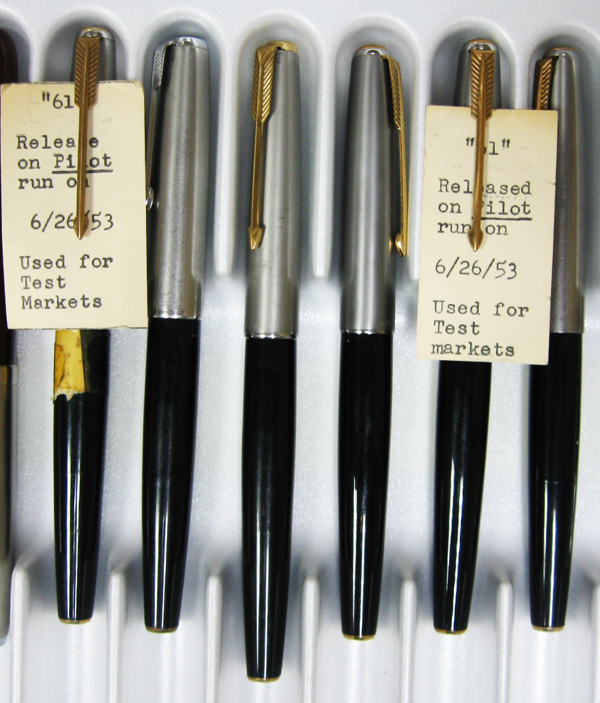
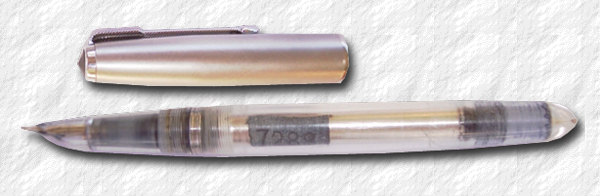
Six prototype Parker "61" from the Experimental Archives
used in test marketing in 1953.
Photography © 2009 by Tony Fischier courtesy of The Parker Pen Company Archives.
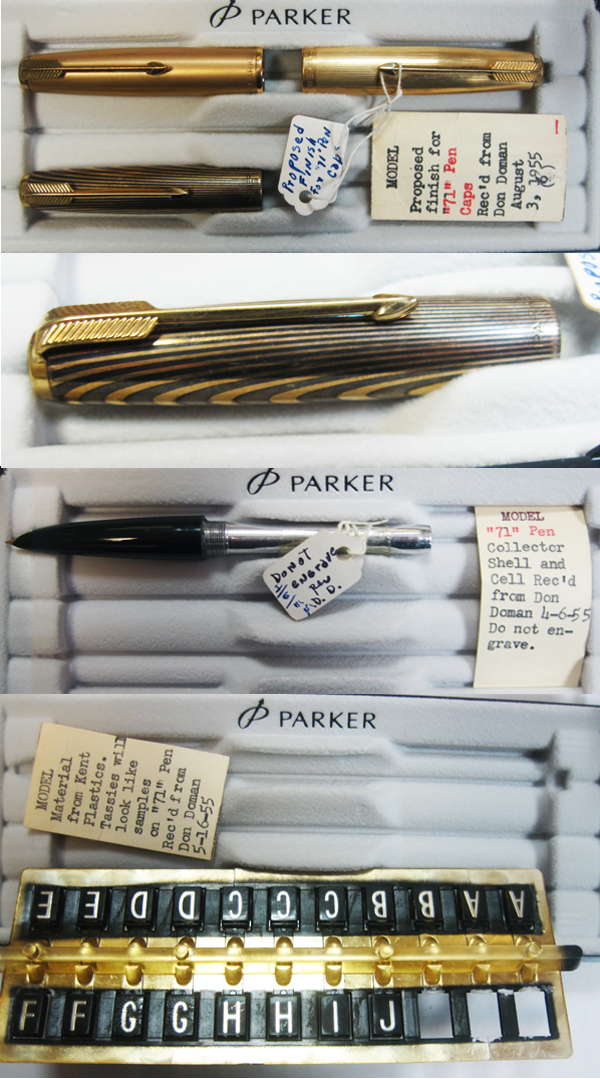
Parker "71" parts from the Experimental Archives.
Note the fantastic prototype Rainbow cap.
Since the Parker "51" was still immensley popular it was decided that the new pen should be based on this winning design. But it was slimmer and had a newly designed tubular nib, a cap and a tassie ring (as did the first Parker "51"s). It also sported a 45 millimeter long arrow clip of a slimmer design than that of the Parker "51".
The Parker "61" was first test marketed in 1953. The first prototypes didn't have the Rainbow cap and was very similar to the Parker "51" in appearence. All pens found have been black and had a silver foil capillary system. Most interesting is that this pen was not filled by unscrewing the body cap inserting the back of the pen in ink. This pen was filled by immersing the nib. Probably in 1954 the Parker "61" prototype, referred to as the mk II (although there were many variations in lenghts and clips designs) was test marketed. Most of these pens were also black but had a cellophane ribbon foil. These pens are well known among Parker collectors and are indeed one of the most common prototype Parker pens found in the wild. They have the number "61" engraved on both the barrel end and under the nib. The caps were in steel or Lustraloy and the clips are transitions between the "51" and "61" designs. The Parker expert L. Michael Fultz estimates that there are several hundred items of the "61" mk II prototype in collector's hands, Most are black, only a handful has been found in other colours.
When the features became more distinct and the Rainbow cap was added to the design one could speculate if Parker felt it was so different from the first pens that the model number deserved an upgrade. But work on both models were probably done simultaneously. In the Parker Archives there are examples of the Parker "71" pen Rainbow cap, retrieved from Don Doman, as well as several other prototype parts. See more images in the
Parker "71" chapter. There was even a Parker "51" prototype made with both the cap and body in a fantastic pattern of silver, gold and brass, as well as a parker "51" prototype with the capillary filling system fitted.
Curiously enough there was a memo from Kenneth Parker's son Daniel Parker from October 1955 where he stipulated that the new pen should be referred to as the Parker "61" mk II, and the Parker "71" name was promptly dropped. Kenneth Parker had stepped down as president in 1952, but remained as chairman.
So, eventually in september 1956 the new pen was introduced in the US. Europe was not to see the revolutionary pen until some five years later.
One of the most attractive features of the first Parker "61"s was indeed the duo-tone Rainbow caps. They were made in layers of different metals, creating a striking appearence. According to Parker it took twelve years of work by a 50-person research team to develope the Parker "61" filling system and it really was revolutionary.
Photography ©2009 by and courtesy of Itzak "Tsachi" Mitsenmacher.
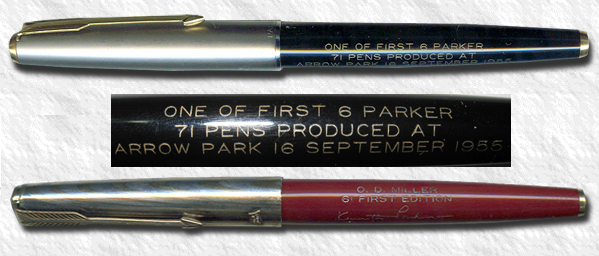
Two phenomenal Parkers, one of the first six Parker "71" made, followed by a first edition Parker "61", with the signature of Kenneth Parker on the barrel.
Parker had reasoned that a filler without moving parts would be preferred by everyone. The customers would benefit from it's simplicity and it would also simplify the production process, it would be economical not having to manufacture and fit a multitude of small parts. And this would of course also benefit the after-sale repairs. During the second world war a railway engineer by the name of Fred Wittnebert had come up with the idea of taking advantage of the capillary force, the same natural force that allows trees, a hundred meters tall, to be able to "suck" water through the stem using the surface-tension that lifts the liquid and keeps it trapped when inserted in a narrow space. The idea wasn't really far fetched, Parker had been using the same force together with the vacuum effect to regulate the flow in the ink feeds for ages.
Wittnebert got the idea while working with Eversharp, who was manufacturing parts for a gyroscope compass for the US. Army Air Corps and offered it to them but they declined. Instead he managed to sell the idea to the Alexander Pen Company in S:t Louis who in turn sold it to Parker in 1949. Parker later hired Fred Wittnebert to develope the filler. Together with the industrial designer Nolan Rhodes he worked with Dupont plastics, the company had been pivotal in producing the plastic dyes used in the Duofold production in the 1920's and the celluloid used to make the Vacumatics during the 1930's and 1940's.
Now Dupont developed a thin polyethylene sheet, 50 by 140 millimeters, punctuated with holes that was designed to hold ink with the capillary attraction. The sheet was rolled up inside a metallic, teflon coated tube that had three holes at the end. It was designed to be inserted into an ink bottle and the capillary force would then literally suck the ink into the pen, without flipping levers, pressing buttons or screwing rods.
The nib assembly was similar to that of the "51", featuring a tubular 14K gold nib ("Plathenium" tipped) with a Lucite feed inside and a collector around, inside the gripping section shell.
Unfortunately the filling system had proven complicated from a manufacturing point of view. It was tough to get the capillary film to fit inside the tube in a correct way. as before mentioned the section arrow had a tendency to fall off and there were also production problems with the rainbow caps since it was hard to keep the different metals to stay together. They tended to separate and the production reject rate was high. Don Doman finally realised that the rainbow caps weren't economically suitable for a long term production run and after three years, in 1959, the caps that held nickel and silver and silver and gold respectively were discontinued. But Kenneth Parker fought for the pattern and was unwilling to shut the production down completely and hence the cap that had proven the least complicated, the Heirloom, which was made from two tones of gold remained in production until 1967.
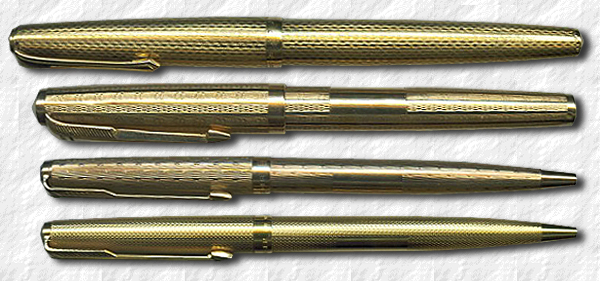
Photography ©2009 by and courtesy of Itzak "Tsachi" Mitsenmacher.
Some phenomenal Presidential Parker "61"s.
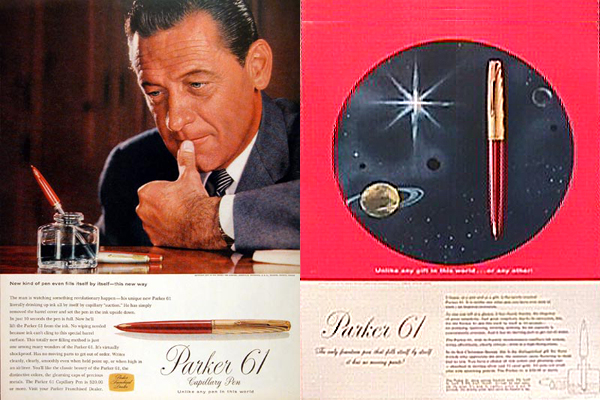
Parker ads from 1957 and 1956.
The Parker "61" line was constantly reviewed and updated. The first
mk I Parker "61" pens (app. 140 mm long) in 1956 had a small shield riveted to the end of the cap with the engraving "First Edition", It's was the first time a pen maker acknowledged a premium design. The Heirloom rainbow cap was introduced in green and pink gold. The barrel colours offered were:

Black
Grey Charcoal
Rage Red
Surf Green (never offered in the UK)
Vista Blue Turqoise
Parker offered seven different "Electro-Polished" point styles in nibs:
Accountant
Extra Fine
Fine
Medium
Broad
Stub
Medium Oblique
In 1957 The Heritage rainbow cap in silver and yellow gold was introduced. A Demonstrator was made to show the novel filling mechanism. Also a Liquid Lead pencil was introduced for the line.
The line-up in
1958:
Heirloom (green and pink gold Rainbow cap)
Heritage (silver and yellow gold Rainbow cap)
Legacy (nickel and silver Rainbow cap)
Custom (Gold filled cap and rolled gold clip)
Deluxe (Satin lustraloy cap and rolled gold clip)
Classic (Satin lustraloy cap and chrome plated clip)
Standard (Lustraloy cap and chrome plated clip)
Demonstrator (not part of the regular line)
Before christmas 1958 two new high end designs was added to the line, the
Insignia, with a gold filled cap and barrel and rolled gold clip, this pen was initially referred to as the
Jet Flighter, it's also referred to as the
Signet. They came in the attractive finishes of
Waterdrop
Fine Barley
Chased
Plain??
The second pen was the Presidential, with solid 14K cap, barrel and clip.
In 1959 the Parker "61" Flighter in stainless steel with chrome plated trim was introduced while the rainbow cap Legacy in silver and nickel was discontinued as well as the Heritage in silver and yellow gold. The barrel colour Surf Green was also discontinued.
In 1961 the finishes offered were:
Black
Blue
Red
Charcoal Grey
Presidential (14K solid gold pen)
Insignia (1/10 12K gold filled pen)
Jet Flighter(Lustraloy pen with chrome clip)
Heirloom (1/10 14K gold filled 2-tone cap)
custom (1/10 14K gold filled cap)
Classic (Lustraloy cap with chrome clip)
©2009 Image courtesy of Francis Meinhardt and The Parker Pen Company Archives.
A Parker "51" prototype fitted with the capillary filer.
Later in 1961 a new 9K solid gold Presidential model Parker "61" was introduced. By now most desk sets could be fitted with a Parker "61" desk pen and in June a desk pencil was also introduced.
In 1962 the Parker "61" Flighter with chrome plated trim was discontinued. The same year the ring between the section and pen body was made thinner, also the cap was shortened a little bit from 62 millimeters to 60 millimeters, these pens are considered by collectors to be the Parker "61" mk II (app. 135 mm long). The Liquid Lead pencil was also discontinued as well as the Demonstrator.
In 1963 Lustraloy cap with a chrome clip replaced the DeLuxe
In 1964 the DeLuxe model with rolled gold trim was discontinued. The same year the Parker "61" was introduced in the UK. These pens were offered with the Heirloom rainbow cap only.
In
1965 the UK line comprised of:
Classic
custom
Heirloom
Ball points were also offered.
In
1966 the following models were offered in the UK:
Classic
custom
Heirloom
Insignia
custom Insignia
Flighter GT
Presidential in 9 or 18K solid gold
In 1967 the Parker "65", wich was very similar to the Parker "61" but with an open nib, was introduced. The ball point pens was made to compliment both lines. Also in 1967 Parker in the UK introduced a Parker "61" line called Consort, which had a cap that held twice the gold of the Insignia, in 12 carat rolled gold cap and barrel in an intricate "brick" or grid pattern with deep lines. This replaced the last of the rainbow caps; the Heirloom in green and pink gold which was discontinued.
Models in 1967:
Consort
custom
Classic
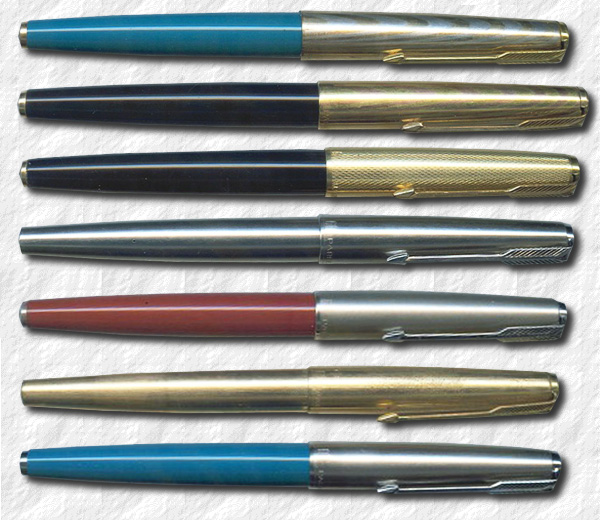
Photography ©2009 by and courtesy of Itzak "Tsachi" Mitsenmacher.
From the top:
Turqoise with Heritage silver and gold cap (1957—1959)
Black with Heirloom pink and green gold cap (1956—1967)
Black with chased rolled gold custom cap (1958—1977)
Flighter CT (1959—1962)
Red Classic with satin lustraloy cap (1958—1975)
Insignia (aka Jet Flighter, aka Signet) (1958—1980's)
Blue Standard with lustraloy cap (1957—82)
In 1969 the legendary capillary filling system was discontinued in favour of mk III, a cartridge/converter fillied pen in the manner of the Parker "45". The capillary "61" was one of the last Parker models that didn't take converters. The inner cap was also redesigned this year, but the new design proved catastrofic since it fit so snug to the section that it sometimes scratched the inlaid arrow or even dislocated it. The connector was now in black plastic and the barrel threads was also different.
1969 also saw the introduction of new barrel colours. The Caribbean green and Rage Red was discontinued and the colour line-up was:
Turqoise Blue
Black
Maroon
Grey
The Presidential was now offered in two new designs:
Flammé
Chevron
In 1970 a Flighter deLuxe model with rolled gold trim was introduced for both the Parker "61" and Parker "65" lines.
By 1971 a Presidenial 14K solid gold desk pen with a short black taper was offered for $75.
In 1972 the Consort insignia model was discontinued.
In
1973 the Presidential desk pen was phased out.
In
1975 the Classic, with a satin Lustraloy cap was discontinued and also on all the models, save the Presidential, the grey plastic jewels of the previous years were replaced by a dome-shaped metal version. Another small design change was that the clip now sported a thinner washer. Also a line of attractive finishes referred to as the cloud collection was introduced:
Cirrus
Stratus
Cumulus
In 1976 the felt-tipped Parker "61" was introduced.
In 1977 The Parker "61" custom with the rolled gold cap was discontinued, as well as the desk set.
In 1979 the felt-tipped Parker "61" was phased out.
In 1982 the cloud series, Cirrus, Stratus and Cumulus was discontinued.
In 1983 both the 9 and 14 carat solid gold Presidential Parker "61" were discontinued. They were the last of the Parker "61"s.
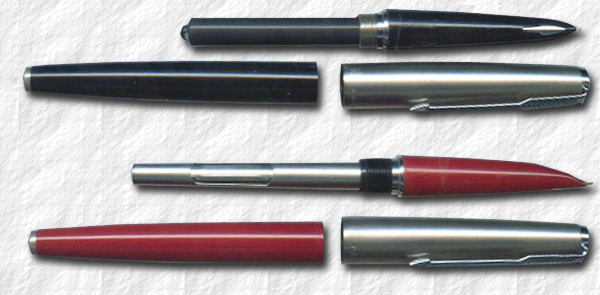
Photography ©2009 by and courtesy of Itzak "Tsachi" Mitsenmacher.
The two filling systems, capillary filler (1956—1969) and cartridge filler (1970—1983)