Kenneth Parker knew that many left handed people had trouble with fountain pens. He even had a large silver desk base made for Dwight D. Eisenhower that held two “51” pens, and that had special ground nibs; one right-handed and one left-handed. The trouble was that unless a left-handed person held the pen in an akward position they would drag the hand through the wet ink while writing.
Furthermore it was expensive and time-consuming to repair the Parker ”51” and Parker ”61” that were Parkers best selling pens at that time. Some customers also wanted special nibs. Collectors of Parker ”51” know how hard it is to find extra broad nibs on these pens. Most pens needed to be sent back to the factory to be refitted with the customised nibs.
Kenneth Parker was playing around with an idea of a pen with an adjustable grip, which would make life a little easier for left-handed writers, and others that preferred a somewhat different writing angle. But this would mean a removable nib unit.
At the same time the injection molding techniques were being refined and Fred Wittnebert, who was the head of Parkers technical division, and among other things had invented the capillary filler for the Parker ”61”, was working on a program to design a modular pen. This would allow parts to fit many different kind of models, which would cut down on the production costs.
The solution was a nib/feed-unit that could be unscrewed and easily replaced. The ideas developed over time into the famed Parker "45". The patents showing the Parker "45" nib, collector and the converter was filed in 1960 and states Homer Ted Green as the inventor. He was also the man behind the T1's integrated nib. However, the new nib-unit that would solve the angle-problem had to wait a few years until the introduction of the Parker ”VP”, and later the Parker "75", but the easily replacable nibs proved a good idea. Nevertheless the road to the finished pen was long and winding.
The razor king King Camp Gilette once worked at a bottle cork seal factory and his boss at one time told him that the secret of success was to produce something that people used a few times and then threw away. Well, while Gillette got his idea one morning shaving, Parker also realised that a cartridge filler for fountain pens would be economically sound.
Parker had put an incredible lot of money and thought into developing new filling systems, first the Button filler, then the Vacumatic filler, the Aerometric filler and then the Capillary filler, and was at first hesitant to convert to non integrated filling systems of their own. They had also had a short lived experiment with a cigarette lighter called the Parker Flaminaire (1950-1952) that contained a replacable cartridge of liquid lighter fluid. Unfortunately these cartridges could not easily be refilled, which soon rendered the discontinued lighter useless. Parker had many complaints from dissatisfied customers that had paid good money for a lighter that would no longer work.
1943 ad.
Scanning the competitors, Parker realised that the cartridge filler that worked best was patented and made by the Wahl-Eversharp company for their CA ball pens.
The Parker-Eversharp story really started with a patent infringement.
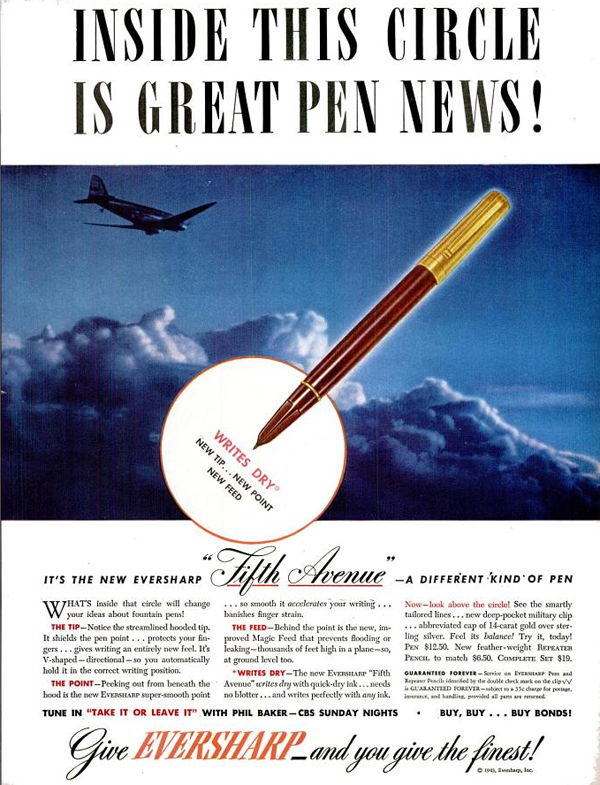
After Argentina-based Lászlo Jozsef Biró patented the first functional ball pen back in 1941, the US pen company Wahl-Eversharp decided that they wanted to get on that train. They had just launched their highly acclaimed Skyline model, designed by Henry Dreyfuss, but the company needed to find new markets to stay afloat, especially in the light of Parker's unprecedented success with the Parker "51". Wahl-Eversharp tried their own version of a fountain pen with a hooded nib, the 5th Avenue, which was introduced in 1943. It was even advertised with an aeroplane, like the early Parker "51" ads! Wahl-Eversharp also decided to secure the rights for the ballpens for the American market and in May of 1945 they did indeed buy the rights from Biro's company and developed a ball pen under the Eversharp name. They spent a staggering two million dollars on this venture. Eversharp released a prototype ballpoint pen to journalists already in May of 1945.
However, before they had a chance to launch their new pen they were astounded to see that an American businessman from Chicago, Milton Reynolds, began selling his own ball pen, Reynolds Rocket, based on Birò's patent, through the department stores of Gimble. This took place in October, before Eversharp's official release. Reynolds had actually flown to Buenos Aires to get hold of the Birò patent, but to no avail. This didn't discourage him from producing his own pen. He launched a massive ad campaign and Eversharp couldn't stop him from eventually selling millions of ball pens. Of course a legal battle followed and Eversharp had no other choice than to launch their own pen, the "CA", even though it hadn't yet been fully tested.
Eversharp launched the CA late in April 1946 following an unprecedented concentration of ads. In New York alone Eversharp bought ten full pages on a single day. This was of course a strategy to make up for time lost.
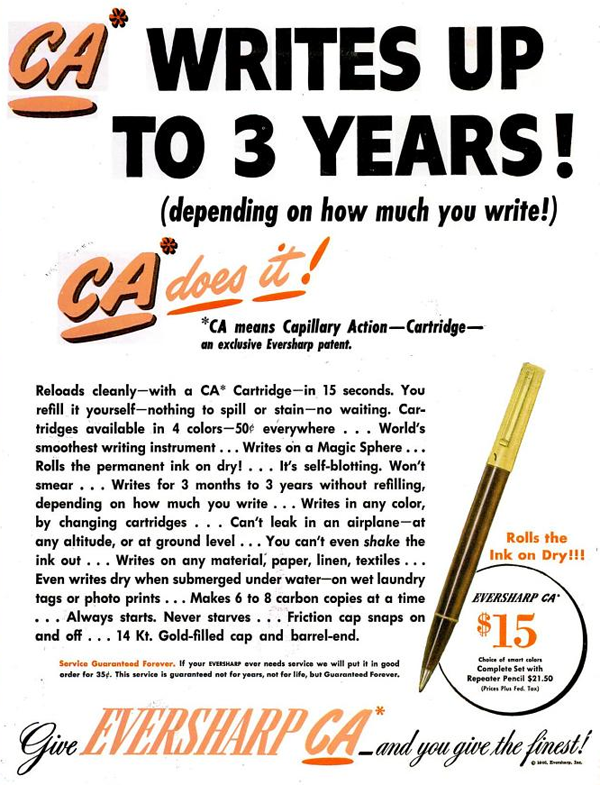
The first "CA" ball pens, which stood for Capillary Action, were designed like the Skyline fountain pens and they utilised another novelty, a cartridge filler. When it turned out that the Reynold ball pen was a poor product, the demand for ball pens quickly diminished, and when Eversharp also realised that the CA was a defective product the company was in severe trouble. Eversharp had sold the CA with a lifetime guarantee and when honouring this, they made a loss of $3 million on returns alone. They were going broke, and fast. Furthermore it turned out that the slow drying ink made it possible for forgers to lift signatures from one document and stamp it on another, creating a perfect forgery.
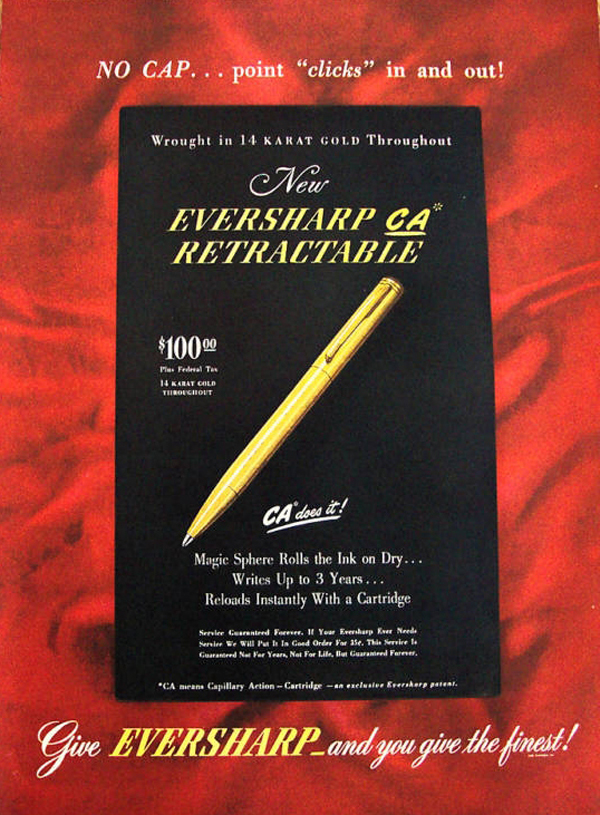
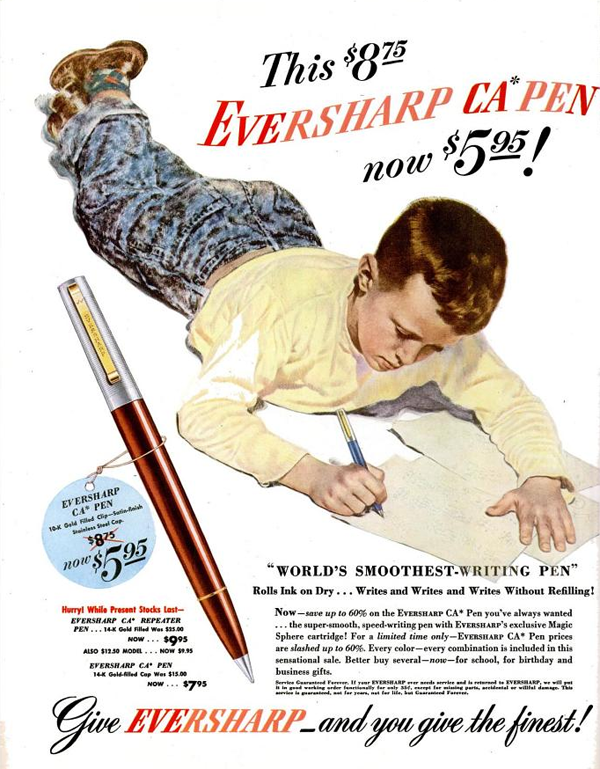
1946 ads.
Eversharp also manufactured the CA for the Fifth Avenue line, but this line proved unsuccessful, mainly becuse the design prevented a reasonable ink-supply for the fountain pens, and the pens were discontinued already in 1946. The same year a retractable CA was introduced without a cap. Initially the CA cost $15, in March of 1947 the price was down to $8.75, in October it was down again to $6.75 and eventually it hit rock bottom at $5.95. Eversharp then decided that the name "CA" was so stained that it was removed from all advertising. In 1948 the pen was renamed the Super-sphere and priced at $7.95, "made to sell for $15".
Eversharp decided to try to repeat the success with the Skyline, by hiring the industrial designer Raymond Loewy, perhaps most famous for designing the logos for Shell and Lucky Strike, the Greyhound bus and also for a redesign of the Coca Cola bottle. The Skyline model was discontinued in 1948 to make way for the new pen.
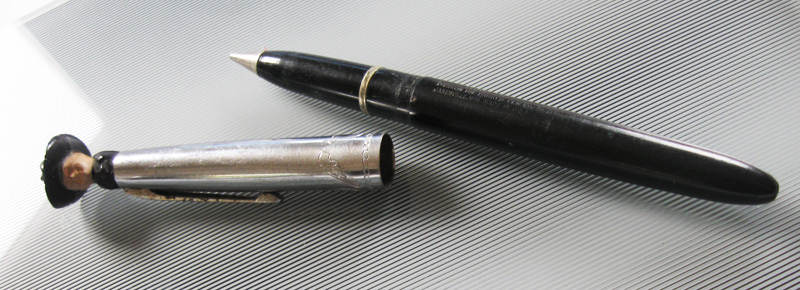
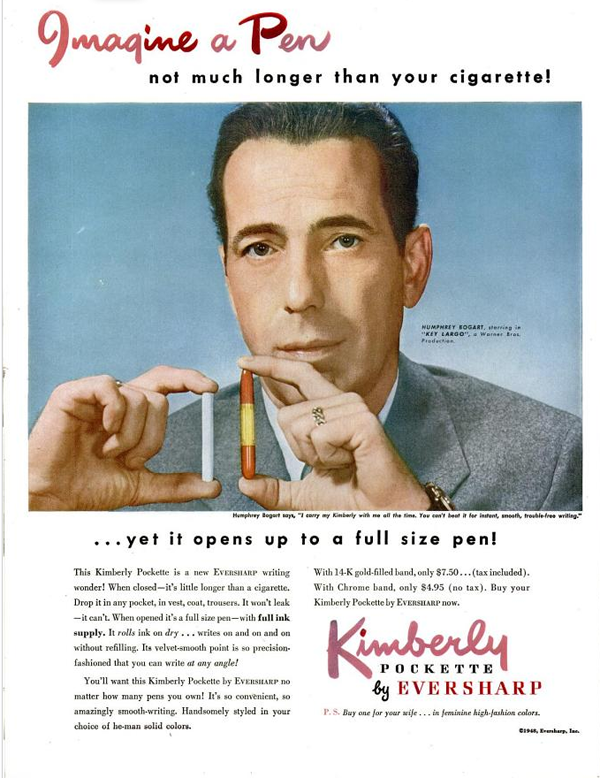
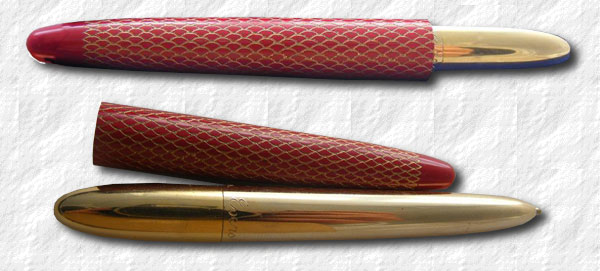
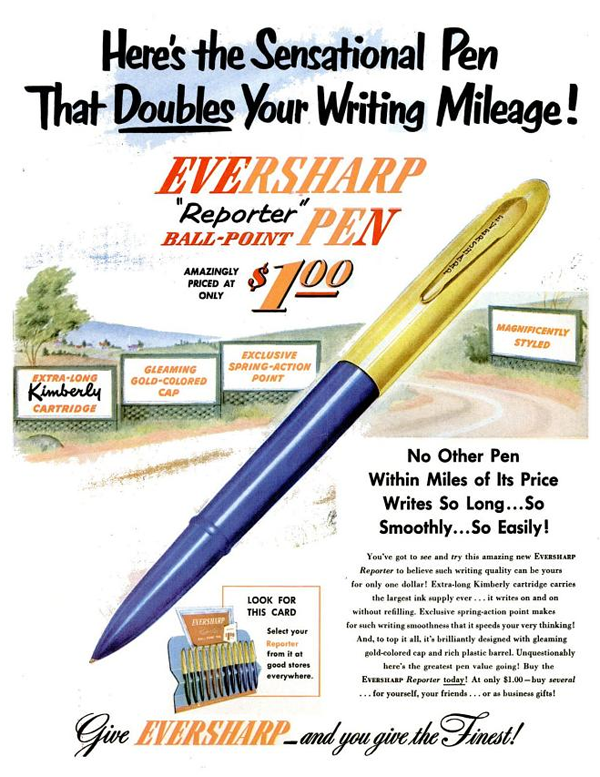
Almost a parenthesis, the Kimberly pen company was a Los Angeles based ball pen manufacturer that Eversharp had sued for two million dollars for patent infringements around 1945. Eversharp eventually ended up buying Kimberly in 1947 dismissing it's action against the company, and, in 1948, the The Kimberly Pockette was introduced, a very small ball pen that turned into a regular size when the cap was posted. Later also regular size Kimberly Eversharps were offered. The Super-sphere-name was replaced by the more prosaic Reporter the same year.
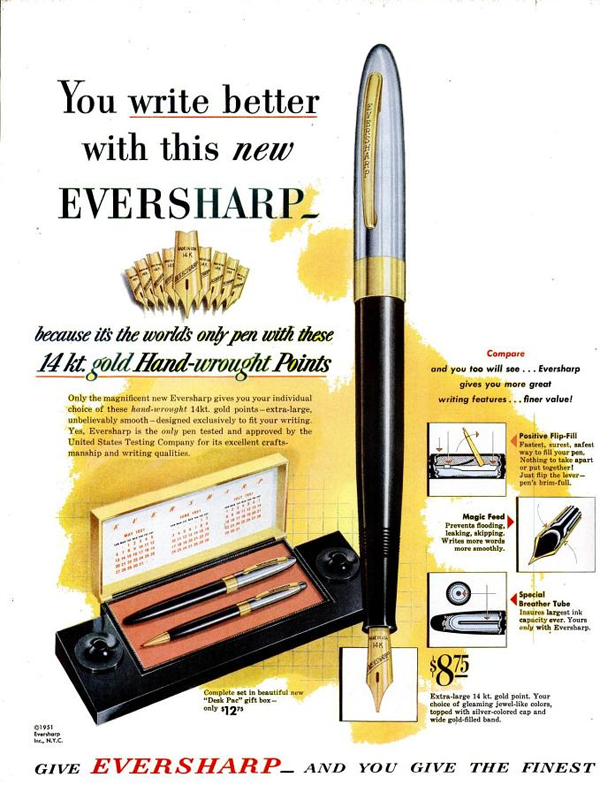
Right before christmas in 1948 the Eversharp Symphony was introduced with a metal cap. They were plastic pens with chrome caps and gold trim, nicknamed "slipper caps" on account of the pens having a "seam" around the rim. The first model was referred to as the 500 and was offered in the colours of Black, Red, Blue and Green. By December the second generation of Symphony was introduced, and came in three different designs, the 701 Standard with a narrow cap band, the 703 Deluxe, which had a wide cap band and the 705 Golden Symphony, with a gold filled cap. The colour range was also enhanced. Furthermore an economy model, strangely advertised as the 707 Luxury, was also introduced. It was very similar to the "705", but distincly smaller.
Although attractive, the Symphony line lacked the innovative features of Eversharp's competitors. It had a standard open nib, it had a lever filler, and it wasn't really all that sexy. Ball pens were of course offered in the Symphony design, but the ball pen market was now standing on clay feet.
Parker sneaked out a ball pen of their own in
1950. It was made by their low end
Parkette department and featured the head of the movie star
 Hopalong Cassidy
. It too infringed Eversharps patent rights, but the law suite between Eversharp and Reynolds had been thrown out of court when it was discovered that Birò had neglected to properly file his patent in the US. Nevertheless Reynolds went bankrupt in
1951 and the Hopalong Cassidy ball pen was first re-designed without the head, and then discontinued the same year.
On December 31, 1951 Eversharp finally gave up on the ball pen business and sold and transferred its rights under the Biro patents to The Parker Pen Company.
1947 ad and the Parker Hopalong Cassidy ball pen.
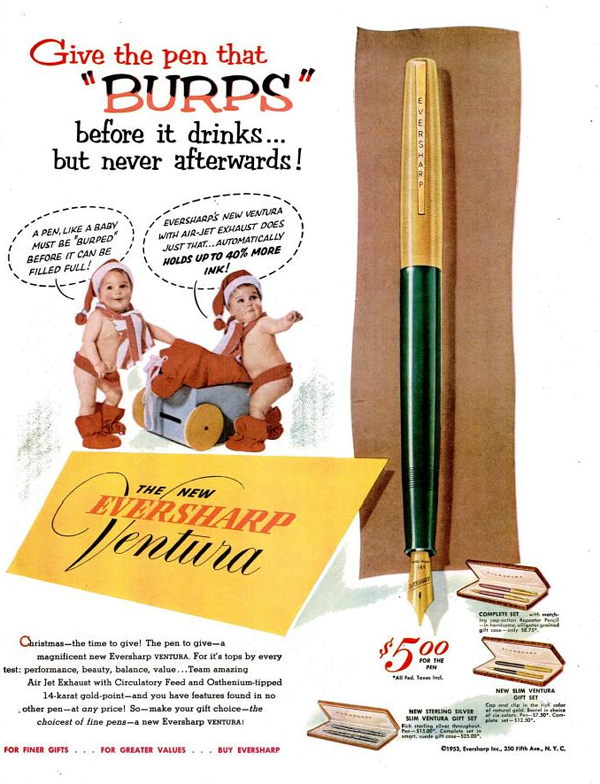
The Eversharp Symphony was redesigned a third time in 1951, most likely to cut production costs. These MKIII Symphonies had a simplified cap, nicknamed the "bullet cap". The 707 was discontinued, also around 1951, and was replaced by an all plastic version, introduced in 1952. The redesign evidently didn't prove much of a success, since the Symphony line was phased out in 1953, to be replaced by the bulb-filler Ventura "Burp" line.
It had a metal, more cylindrical cap than the Symphony line and sported a square clip. The filler was similar to the Parker "51" Aerometric filler but lacked the quality and finesse. It was heavily advertised as the pen that "Burps" and was offered in the six colours of Black, Navy blue, Grey, Green, Brown and Burgundy. There were also all-metal models offered. The Ventura was to be the last of the Wahl-Everharps. The endevour to become Americas prime ball pen manufacturer was definitely crushed in 1954.
Parker had seemed reluctant to make ball pens and this was so strange that Time Magazine in 1946 had an editorial where they contemplated why Parker was napping in the midst of the ball pen boom. This led Kenneth Parker to make a statement in a letter to the magazine that he resented all such nonsense. Kenneth Parker had learnt from his work with the Duofold, the Vacumatic and the Parker "51" how important it was to be really creative and innovative. Only by offering a truly great product would one be able to stay in business.
Right when it was thought that the concept of ball pens was dead, Parker, who had rushed slowly in the middle of the ball pen hysteria, in 1954, after nine years of research, presented their own version of the ball pen, the Jotter. In functionality it far exceeded everything produced until then. It differed in several aspects from Birós, Reynolds and Eversharps pens: it wrote five times as long, it was easy to refill and it came with a choice of nib sizes.
And it worked.
Parker sold 3.5 million Jotters the first year of production and the year 1954 marks the definite turning point when the ball pen exceeded the fountain pen in sales in Europe and the US.
As for Eversharp the company was now virtually broke, and in 1957 the pen-division was for sale. This fitted Parker's plans. While the Wahl-Eversharp razor division remained, by January 1, 1958, Parker had acquired 100 per cent ownership of the writing instrument division of Eversharp, Inc. They paid $1 600 000 for the company, and established it as a subsidiary of their own, as the Parker Eversharp Pen Company.
It was only a matter of months before the first Parker Eversharp cartridge fountain pen was introduced, the metal capped Parker Eversharp
10 000 pen, aka
#501. Looking at it, it really doesn’t resemble what you might expect of a Parker pen from that time, but the cap apart, it was the father of a series of pens made by Parker—Eversharp in the early and mid-1960’s. Parker used their new sub-brand to try out different solutions with the cartridge filler, and eventually the modular nib/feed as the main feature.
1948 ads and the attractive Tiara
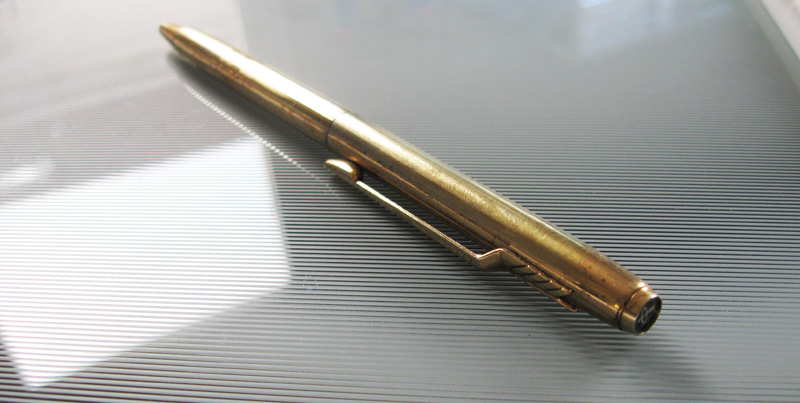
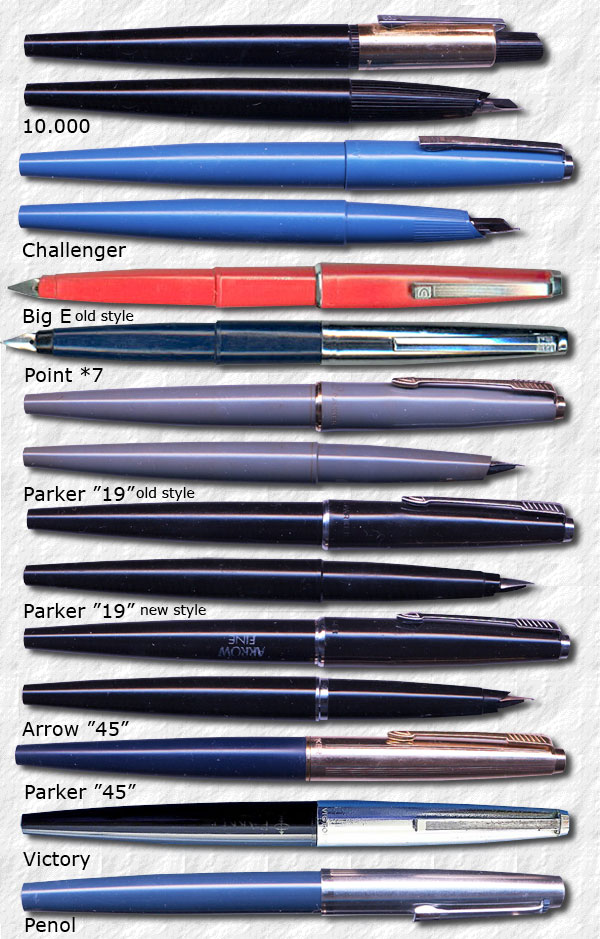
The Parker Eversharp 10.000 pen was offered as a fountain pen, ball pen and mechanical pencil. It had a somewhat strange cap that seems too short for the pen. The clip was very square with the Eversharp “E” engraved at the bottom and a v-shaped clip screw, likely borrowed from the Eversharp Viking/Vanguard series, possibly made in the UK for the Nordic market in the late 1950’s. It also had a strange "backwards" (though not removable) nib collar, protruding underneath the steel nib. The gripping section was striped. It was offered in the colours of Black, Red, Blue, Grey, Green and white.
The 10.000 pen was of course not really a Parker pen, since it was both developed and made by Eversharp in the Culver City factory in California, but it was indeed an important stepping stone for the future business ventures by Parker.
Parker also continued production of the Kimberly Pockette ball pen, now re-named the
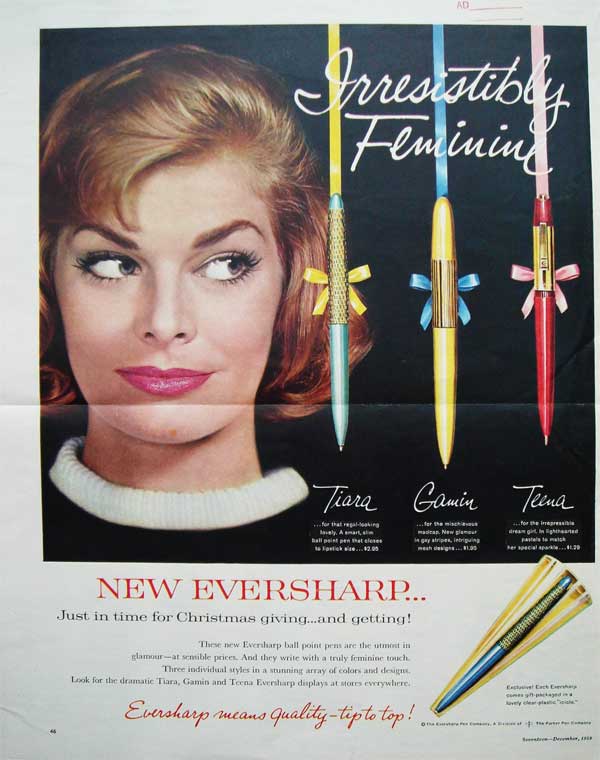
Gamin. Some very attractive metal finishes exist, among others a very attractive pattern in green stripes. It seems to have been aimed at the female population. Versions advertised in
1959 were the
Tiara and the
Teena. Another Eversharp model name that survived was the illusive
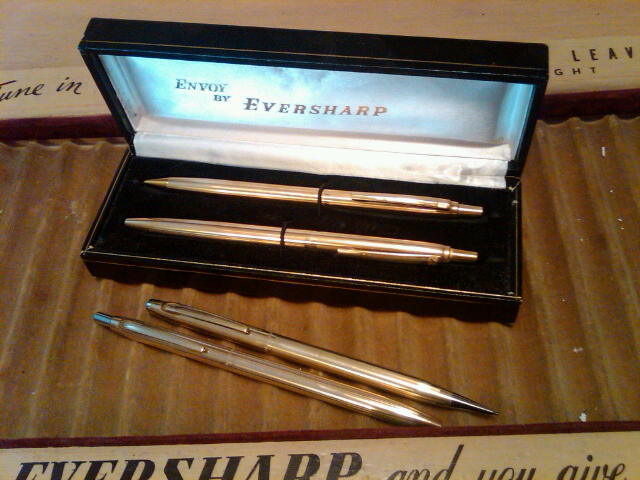
Envoy.
Even though the Parker "45", introduced in 1960, was designed by Don Doman (who also designed the Jotter, Parker 61, Parker VP, Parker 75, Parker T1 and Liquid Lead), he clearly based it on the "10 000".
Parker now had the opportunity to test a range of economy pens.
In the summer of
1961 the Eversharp
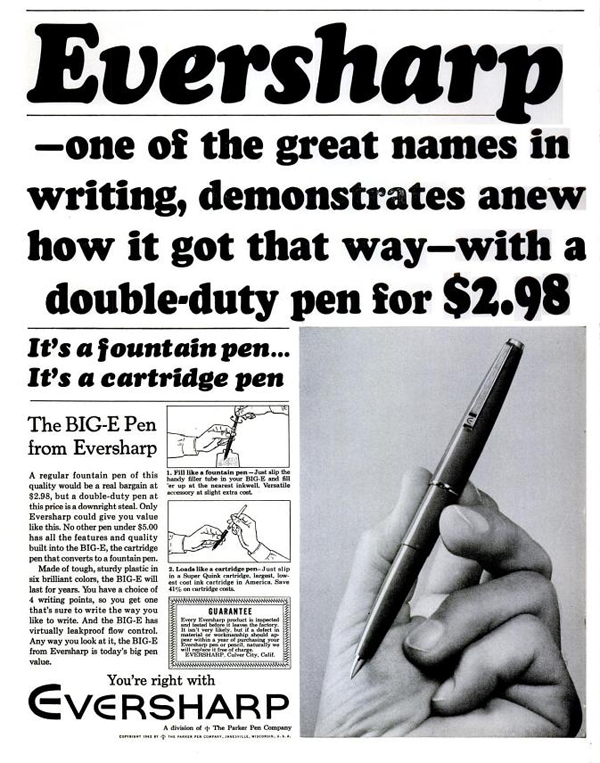
Big E, initially referred to as the
Super E was introduced. It looked very much like the Parker "45", but had a steel nib and a plastic cap with a chrome trim with a chrome cap lip.
Initially the nib/feed unit was not replaceable, the nib collar was in one piece with the section and in the same colour. The clip was very similar to the 10.000 pen, and strangly enough some 10.000 pens have been found wrapped in Big E boxes. The Big-E was priced at $2.98. It was offered with four nib sizes, Extra fine, Fine, Medium and Broad and in the six colours of Black, Green, Dark Blue, Light Blue, Red and Grey. It had a smooth gripping section and longer cap that was not interchangeable with the 10.000 pen.
Parker in Toronto, Canada launched a Big E version of their own in
1961, the
Parker "19", with a "45"-style clip and a non-interchangeable nib/feed. As opposed to the Big E it was offered either with steel or gold nibs and either with chrome trim or with gold electroplated trim and nib. It was offered in the colours of
Black, Red, Dark Blue, Light Blue, Green and Grey.
Both the Parker "19" and the Big E were refashioned in 1962 to incorporate a replaceable nib, like on the Parker "45". Although interchageable, the nib collar was a little different in design, the "45" collar covering more of the nib. The Big E was then sold complete with a free cartridge and new converter, which ordinarily was a 49-cent item.
Also in 1962 a cheaper cartridge pen with a plastic cap and body, called the
Challenger was launched to "challenge competition". It sold for
$1.00 with two free cartridges. It was bubble-packed to a card "for consumer convenience". The Challenger was also based on the 10.000 pen and had a very similar striped gripping section, but the nib collar, although still not removable was turned 180 degrees from the one on the 10.000 pen, creating a contour close to the Parker "45", albeit in the same colour as the pen. It had a chrome trim, but lacked the metal cap lip of the Big E.
1950 and 1951 ads, the Parker Eversharp Doric and the Envoy (image courtesy of Jonathan Veley).
The Eversharp "10.000" was still being offered in 1962, as was the Reporter ball pen, but both were being phased out. It now sold with a special offer. If the purchasers returned two empty cartridges with a coupon on the back of the card-pack they received a refund of $1.00 on the $1.98 they paid for the pen. And, purchasers of an 88-cent Eversharp Reporter ballpen could pay a penny more and receive a 39-cent utility Eversharp.
Parker Eversharp also offered the The
Parker Doric, an alternative to the Jotter, in 1962. They were also available as a rotary pencil and twist actuated ball
pen in either
Sterling silver, Gold plated or 14k gold. The Doric was however discontinued within a couple of years.
In 1962 Parker introduced the $3.95 Parker "45" Arrow cartridge pen. The Arrow was aimed directly at the 22 million young people in high school and college. The price of the Arrow, coupled with values like a 14-karat replaceable point and cartridge convenience, was designed to attract them to Parker products. A smaller sized Lady "45" was also offered, a "smartly styled version of the Convertible pen". Two models were offered; the gold Lady "45" with its cap screw and barrel tassy fashioned of an impregnated wood material, and the chrome Lady "45" with cap screw and tassy matching the grip area.
Another sibling that used the Parker "45" feed and nib was the
Varsity, a seldom seen pen marketed in
1963. They came in the colours of
Black, Red, Charcoal, Blue, Beige and possibly
White.
As the name suggests, they were aimed to be sold to students. They had a transparent plastic collar around the top of the section so that the student could personalise the pen by inserting a piece of paper with a name on it under the plastic. It had a very distinct clip, crocodile-style, and a gripping section with indentations for a better grip. They didn't have the gold nibs of the Parker "45" and another difference was a stainless steel tassie ring.
Items in the Parker archives also suggests that the pens were sold either with stainless caps or plastic caps, Parker "45" Arrow style. The Varsity was also some 10 millimeters shorter and more "stubby" than the "45".
Another uncommon "45" family member was made in Canada, probably around
1963, a
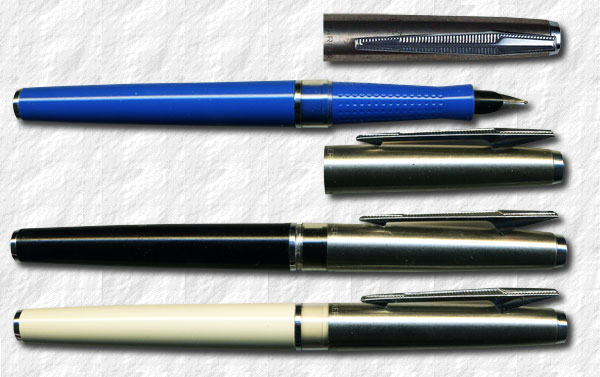
Victory with a metal cap and an Eversharp-styled clip, although without the "E". It too utilised the screw-in nib/feed of the "45". There is also a Danish made
Penol, that sports the Eversharp clip, but the little square where the "E" should be have been is chased. This clip seems to be held in place by as mall plastic gear.
By
1964 the 10.000 pen, the Challenger, the Parker "19", Reporter, Gamin and the Big E had been phased out. Instead Parker Eversharp was offering the pen with the curious name, the
Point *7. It was offered as a fountain pen, mechanical pencil and ball pen. The fountain pen was offered in the colours of
Black, Light Blue, Dark blue, Grey and
Red with a metal cap. The ball pen was also offered in the additional colour of
White. It sported a "ridged" clip, similar to the one found on the
Parker "21" with the "E" at the top of the clip.
1953 and 1962 ad and the Parker Varsity (courtesy of Tsachi Mitsenmacher).
Other Eversharp products were the
Deluxe ballpen and mechanical pencil, offered in the colours of
Green, Black, Blue, White, Red and
Grey, and the Envoy ballpens and pencils with 12k gold filled caps and barrels. The
Diplomat was another pen and pencil set sold with an "Ever-chrome cap and barrel". Two styles of desk sets, the
D-300 and
D-305 was also offered in
Black, Light Blue, Green, Red and
Ivory.
A Point *7 version with a plastic tip, the
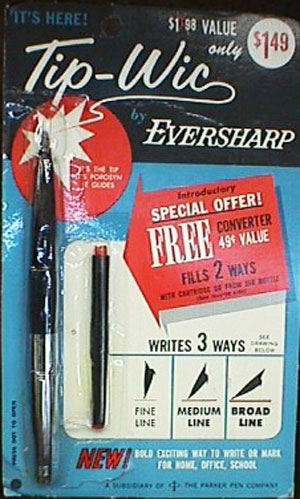
Tip Wic was introduced around
1965 and was described as "a new and exciting way to write. Its innovative Porosyn tip glides as you write a fine line, a medium line and even when you create a broad line."
Around 1966 Parker Eversharp were fiddling around with other desk-top producs, like the Eversharp pointer, a pen like tool that could be elongated into a rod, and the Time & worksaver ensemble, a turqoise-green box containing four handy mini-tools with bright orange handles; a Clipit paper cutter, a Minifix with small screwdriver, a Letteropener and a Handyknife.
The tools had come out from the Parker Special Products Division, which was organised in 1960, who by 1965 had come up with some 119 different producs. The Clipit was launched already in August of 1961. The Drivit screwdriver, with three interchangeable blades, the Dew'it push-button moistener, the Sta-pul staple remover and the Redi-clip clip-dispenser, were among other things produced.
But business wasn't going very well for Parker, and the economy Eversharp pens were never able to really compete with the other companies making cheaper pens at this time.
George Parker, who was the president of Parker in the late 1960's explained:
"All the market surveys said go lower, go lower, that's where the business is. But, we don't know how. We bought Eversharp and tried to run it ourselves, and we couldn't do it. Our people just couldn't think in terms of big units, and they didn't know how to sell people on the lower priced end of the business — grocers, supermarkets, rack jobbers. The result was, Bic and Paper Mate were cleaning up the lower priced end, Cross in the high, an Parker was getting squeezed in the middle. Volume was going up, but our costs went up faster, and our profits were squeezed."
In 1968 Parker decided to shut the Eversharp division down.
Special thanks to David R Cress, Matt McColm, Antonios Zavaliangos, Lynn Sorgatz, Daniel A Zazove, Jim Mamoulides, Ricardo Thomson, Don Lamkin, Paul Barrell and Tsachi Mitsenmacher.
A comparison of the "45"-family and a 1959 ad.
The Tip-Wic Point *7